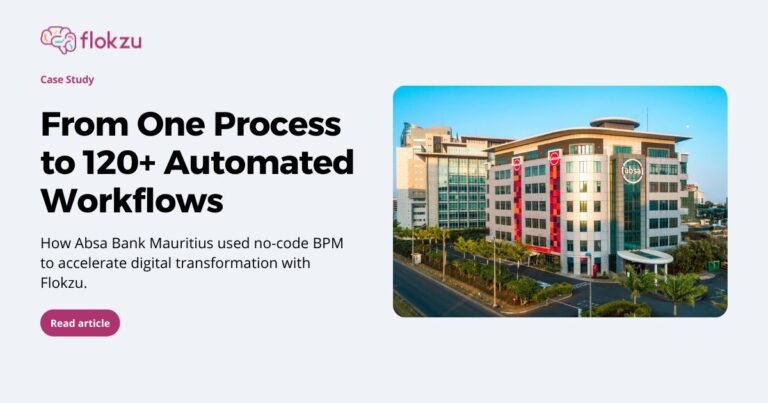
How Absa Bank Mauritius used no-code BPM to accelerate digital transformation with Flokzu.
Financial services organisations across Africa are under pressure to digitise faster, improve customer experience, reduce operational risk and maintain internal control. But many process improvement initiatives get stuck because IT teams are overloaded, legacy systems are complex and business teams still depend on email, spreadsheets and manual approvals.
The Absa Bank Mauritius success story shows what happens when process automation becomes easier to deploy, scale and manage across the organisation.
What began as one automated workflow grew into more than 120 automated processes across areas such as purchasing, legalisations, meeting minutes, inventory, contracts and innovation control.
Executive Summary
Absa Bank Mauritius shows how a financial institution can move from isolated automation to scalable, organisation-wide process transformation.
The case is especially relevant for South African and African financial services organisations because it demonstrates how no-code BPM can help banks accelerate digital transformation, reduce manual work, improve turnaround time and give business teams more autonomy without requiring every process change to be built from scratch by IT.
Key Takeaways
- Absa Bank Mauritius began working with Flokzu in 2020 as part of its digital transformation journey.
- The project started with one process and expanded into more than 120 automated workflows.
- Customer onboarding time was reduced to about 15 minutes by removing much of the manual layer.
- No-code BPM helped business teams build and adjust workflows without writing code.
- The case provides a strong proof point for banks and financial services companies in South Africa looking to scale automation responsibly.
Why This Case Matters for Financial Services in South Africa
Financial services organisations across Africa face a similar challenge: they need to digitise faster, improve customer experience, reduce operational risk and maintain internal control.
But many automation initiatives are still treated as isolated technical projects. A team automates one workflow, solves one pain point and then starts again from scratch when another department needs help.
The Absa Bank Mauritius case offers a different lesson. Instead of treating workflow automation as a one-off implementation, the bank used Flokzu as a platform to expand automation across multiple teams and workflows.
For banks, insurers, fintechs and financial teams in South Africa, this is the real opportunity: automation creates more value when it becomes a repeatable capability, not just a single technical implementation.

The Challenge: Bottlenecks in a Digital Transformation Journey
Absa Bank Mauritius had a clear vision: becoming a fully digital institution. To move in that direction, the bank needed a way to overcome operational bottlenecks and modernise processes that were still too manual, slow or dependent on internal development capacity.
In financial services, these bottlenecks usually appear in familiar places:
- Customer onboarding.
- Internal approvals.
- Document-heavy processes.
- Procurement requests.
- Contract workflows.
- Compliance follow-up.
- Meeting minutes and internal governance.
- Inventory and back-office control.
When these workflows depend on email chains, spreadsheets or informal follow-up, teams lose visibility. Managers cannot easily see where requests are stuck, who needs to approve them, which documents are missing or how long the process takes from start to finish.
The Solution: No-Code BPM as a Scalable Automation Layer
Absa Bank Mauritius partnered with Flokzu to automate business processes using a no-code BPM approach.
The value of no-code BPM is that business teams can design, launch and improve workflows without needing to write code for every change.
This matters because banks need both speed and control. They need to move faster, but not at the expense of traceability, governance or process consistency.
With Flokzu, teams can structure workflows around forms, tasks, roles, approvals, notifications, deadlines, escalations and process metrics. This allows the organisation to move from scattered work to controlled, measurable workflows.
The project started with one automated process and later expanded into a broader digital transformation initiative across multiple areas.
The Results: From One Process to More Than 120 Automated Workflows
The results reported in the public Absa Bank Mauritius success story are clear:
- More than 120 processes automated across different areas.
- Customer onboarding time reduced to about 15 minutes.
- Automation expanded into purchasing, legalisations, meeting minutes, inventory, contracts and innovation control.
- Teams gained more autonomy to deploy workflows without writing code.
- Turnaround time became more visible and easier to manage.
One of the strongest points of the case is that it goes beyond efficiency. It shows how automation can become part of the organisation’s operating model.
When teams begin to think of processes and Flokzu together, the platform is no longer just a tool. It becomes a shared way of working.
Why No-Code Was Critical
Traditional software development is not always the best route for every workflow.
In large organisations, IT teams already manage core systems, cybersecurity, integrations, infrastructure and strategic projects. If every internal process improvement requires custom development, the backlog grows quickly.
No-code BPM changes that dynamic.
It allows business users to:
- Describe and structure their processes.
- Adjust approval flows.
- Build escalation rules.
- Create forms.
- Monitor turnaround time.
- Improve workflows after launch.
At the same time, IT can remain involved where it matters most: governance, access control, integrations, security and architecture.
This balance is especially important in banking, where speed must be combined with reliability and oversight.
What South African Banks Can Learn from Absa Bank Mauritius
The Absa Bank Mauritius success story offers five lessons for financial services companies in South Africa.
1. Start with one high-impact process
Absa did not need to automate everything at once. Starting with one process created a path to prove value, learn and scale.
2. Build internal automation capability
The real value of no-code BPM appears when teams can keep improving workflows over time, instead of depending on external development for every change.
3. Measure turnaround time
Visibility into turnaround time helps managers identify bottlenecks and improve service delivery.
4. Expand beyond customer-facing workflows
Customer onboarding is important, but back-office and internal workflows also create significant value when automated.
5. Make automation part of the culture
When process automation becomes familiar to business, operations and customer experience teams, digital transformation becomes more practical and sustainable.
How No-Code BPM Supports Banking Process Automation
Banking process automation requires more than speed. Financial institutions need structured workflows that support control, visibility, traceability and continuous improvement.
No-code BPM helps banks and financial services teams automate processes such as:
- Customer onboarding.
- KYC and document collection.
- Internal approvals.
- Procurement requests.
- Contract review.
- Compliance follow-up.
- Audit preparation.
- Back-office operations.
- Innovation and governance processes.
For South African financial services organisations, this approach can help reduce manual follow-up, improve service delivery and give teams more visibility into how work moves across departments.
Final Thoughts
The Absa Bank Mauritius case shows that no-code BPM can help financial institutions move from manual, fragmented processes to scalable workflow automation.
For South African banks and financial services companies, the opportunity is to use automation not only to reduce manual work, but also to build a more visible, agile and measurable operating model.
Ready to Automate Complex Banking Workflows?
Ready to explore how your financial services team can automate complex workflows without increasing IT backlog?
Book a Flokzu demo and see how no-code BPM can help your organisation move faster with control.
Suggested demo link:
https://flokzu.com/en/request-a-demo/
Frequently Asked Questions
What is the Absa Bank Mauritius Flokzu case study about?
The Absa Bank Mauritius Flokzu case study shows how the bank used Flokzu’s no-code BPM platform to scale process automation from one workflow to more than 120 automated processes across different business areas.
How many processes did Absa Bank Mauritius automate with Flokzu?
According to the public Flokzu case study, Absa Bank Mauritius automated more than 120 processes across areas such as purchasing, legalisations, meeting minutes, inventory, contracts and innovation control.
How did Flokzu help reduce customer onboarding time?
Flokzu helped Absa Bank Mauritius remove much of the manual layer from the onboarding process, reducing customer onboarding time to about 15 minutes according to the published case study.
Why is no-code BPM useful for banks?
No-code BPM is useful for banks because it allows business teams to automate and improve workflows without requiring custom development for every process change. It also supports visibility, traceability, approvals, notifications and process metrics.
Can no-code BPM help reduce IT backlog?
Yes. No-code BPM can reduce IT backlog by allowing authorised business users to configure approved workflows while IT maintains governance, security, integrations and platform architecture.