
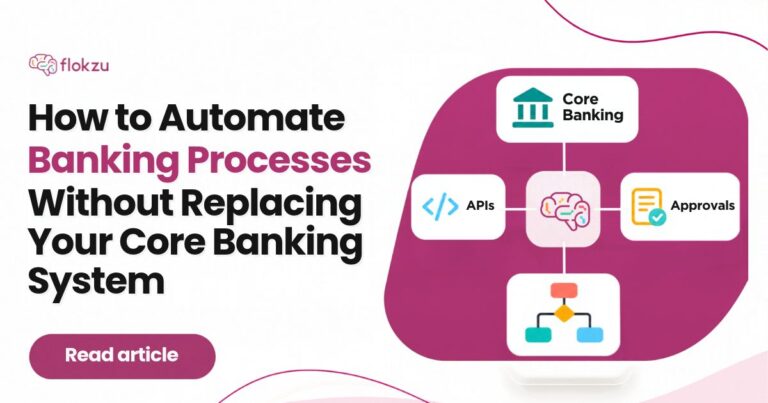
Banks can automate business processes without replacing their core banking systems. A Business Process Management (BPM) platform can coordinate tasks, approvals, and integrations with existing applications while the core banking system continues to handle the institution’s transactional operations.
This approach enables banks to modernize processes such as loan applications, customer onboarding, audits, and internal approvals while preserving their existing technology infrastructure.
With a BPM platform like Flokzu, financial institutions can design workflows, connect applications through APIs and web services, and gain greater visibility into their operations.

The challenge of modernizing processes that depend on core banking systems
A core banking system is the central platform that manages critical banking operations, including accounts, deposits, loans, and transactions.
At many financial institutions, these systems have been operating for decades and are connected to applications for customer relationship management, document management, risk assessment, and regulatory compliance.
Modifying a core banking system can involve significant costs, complex development projects, and risks to business continuity. At the same time, banks must continuously improve their processes to increase efficiency and meet evolving business demands.
Consider a loan application. Processing it may require customer information from a CRM, risk assessments, document reviews, and approvals from multiple departments. When these activities are disconnected, tracking the application’s overall status, identifying delays, and maintaining a reliable audit trail become difficult.
Integrating these activities through a BPM platform allows banks to manage the entire process from start to finish.
How does a BPM platform work alongside a core banking system?
A BPM platform enables organizations to design, automate, execute, and monitor business processes involving people, systems, data, and business rules.
Within a banking technology architecture, the core banking system retains responsibility for transactional operations, while the BPM platform orchestrates the activities that make up each business process.
Core banking vs. BPM: What’s the difference?
| Core banking system | BPM platform |
|---|---|
| Manages accounts, deposits, loans, and transactions. | Coordinates business processes, tasks, and approvals. |
| Maintains critical transactional data. | Manages process data and workflow status. |
| Executes core banking business rules. | Executes workflow rules, assignments, and approvals. |
| Manages operations within the central banking system. | Provides visibility into processes spanning multiple systems. |
The exact division of responsibilities depends on each institution’s architecture. However, this approach allows banks to manage certain operational changes through the BPM platform without continuously modifying their core banking system.
How can Flokzu integrate with existing banking systems?
Flokzu is a low-code/no-code BPM platform that enables organizations to model processes using BPMN, automate activities, and integrate multiple applications.
Banks can use different integration methods depending on their existing infrastructure and technical requirements.
REST Web Services
Flokzu can invoke REST services from within a workflow to retrieve information, send data, or execute operations in external applications.
For example, a workflow can check a customer’s status before proceeding with a credit assessment, provided the relevant system exposes an authorized service.
Flokzu also supports asynchronous services with callbacks and configurable mechanisms for handling errors and timeouts.
Learn more about Flokzu’s REST integrations.
Flokzu’s Public API
Flokzu’s public API allows external applications to interact with automated workflows.
Available operations include creating new process instances, retrieving information from existing instances, and updating process data.
For example, a banking application could automatically trigger a workflow when a new loan application is submitted or send additional information as the process progresses.
Middleware and legacy system integration
When banking systems lack modern APIs, integration may require middleware, intermediary services, or Robotic Process Automation (RPA) tools.
These components help applications communicate, transform data, and connect legacy systems with automated workflows.
The most appropriate approach depends on the technical capabilities of each system and the institution’s security requirements.
Practical example: automating a loan application process
Imagine a bank looking to reduce commercial loan approval times without modifying its core banking platform.
With Flokzu, the process could work as follows:
- Application submission. A relationship manager submits a loan application through a Flokzu form. Alternatively, customers can initiate the application directly through a public form without accessing the platform.
- Information retrieval. The workflow retrieves relevant customer data from the CRM and other authorized systems.
- Risk assessment. Flokzu coordinates the required validations and assigns tasks to the appropriate team members when additional reviews are necessary.
- Approvals. Based on the loan amount, product type, and risk level, the application is routed through the appropriate approval levels.
- Transaction recording and monitoring. Once the application is approved, Flokzu can send the required information to the transactional system through a configured integration and retain references for tracking the operation.
Throughout the process, authorized users can monitor application status, identify pending tasks, and analyze processing times.
The result is a coordinated workflow with clearly defined responsibilities and greater visibility into every stage.
Real-world example: banking process automation With Flokzu
Financial institutions are already using Flokzu to digitize and optimize their business processes.
Bancom: Digitization and integration with core banking systems
Bancom, a financial institution in Peru, implemented Flokzu to standardize and digitize procedures involving customers and employees across multiple departments.
Documented improvements include end-to-end process digitization, electronic authorizations, automated communications, and reporting capabilities to analyze service times.
Bancom also reported ongoing work to integrate Flokzu with its core banking systems, allowing information to be automatically populated into forms, reducing manual data entry, and minimizing potential input errors.
Its experience illustrates how a BPM platform can help modernize banking processes while supporting integration with existing core systems.
Read Bancom’s customer success story.
Security and traceability: key considerations for banking integrations
When connecting a BPM platform with financial systems, institutions must evaluate security controls, service availability, and the ability to track operations.
Flokzu provides process execution histories, responsibility management, and configurable API Keys to control integration permissions.
Before implementing a banking integration, institutions should pay particular attention to:
- Security and access permissions: Define which resources and operations each integration can access.
- Data consistency: Prevent duplicate records and establish which system serves as the primary source of information.
- Error handling: Determine how to respond to connection failures, unexpected responses, or timeouts.
- Traceability: Link workflow instances to operations performed in external systems.
- Business continuity: Evaluate system dependencies and recovery mechanisms to avoid disrupting critical services.
Automation improves process monitoring and the availability of audit evidence. However, regulatory compliance still requires additional controls and institution-specific assessments.
Flokzu Cloud vs. On-Premise: Which deployment model Is right for your bank?
Flokzu offers two deployment options:
Flokzu Cloud: Hosted on Amazon Web Services (AWS) infrastructure, this option allows organizations to use the platform through a cloud-based service model.
Flokzu On-Premise: Enables organizations to deploy the platform within their own infrastructure or private cloud, subject to the applicable technical requirements.
Both options provide Flokzu’s core process automation capabilities.
The best choice depends on the institution’s security policies, regulatory requirements, connectivity with internal systems, and overall technology strategy.
Where should banks start with process automation?
An effective strategy is to start with a high-impact process that involves multiple departments, experiences frequent delays, or requires greater traceability.
Before implementation, institutions should identify the systems involved, assess available integration options, define business rules, and establish measurable success indicators.
Relevant metrics may include approval times, the number of applications processed, error rates, and the volume of pending tasks.
Once the first workflow is automated, the institution can evaluate the results and expand automation to more complex processes.
Frequently asked questions about BPM and core banking
Can Banks Automate Processes Without Replacing Their Core Banking Systems?
Yes. A BPM platform can coordinate activities, approvals, and integrations with existing applications while the core banking system continues to handle transactional operations. Feasibility depends on the available interfaces and technical controls.
What Is the difference between a core banking system and a BPM platform?
A core banking system manages essential banking operations, while a BPM platform automates and monitors business processes involving people, business rules, and multiple applications.
How does Flokzu handle integration errors with external systems?
Flokzu allows organizations to configure error handling for REST services and define alternative paths within a workflow. Timeouts can also be configured for certain integrations.
Can Flokzu be deployed within a bank’s own infrastructure?
Yes. Flokzu offers both Cloud and On-Premise versions, allowing banks to evaluate different deployment options based on their infrastructure requirements and internal policies.
Key takeaways
- Banks can automate business processes while keeping their existing core banking systems in place.
- A BPM platform connects applications, coordinates approvals, and manages end-to-end workflows.
- Flokzu provides REST services, a public API, and additional integration options to connect workflows with external systems.
- Security, traceability, and error handling are essential considerations for banking process automation.
- Experiences such as those of Bancom and Banco Santander Uruguay demonstrate real-world BPM applications in financial institutions.
Automate banking processes without replacing your existing infrastructure
Every financial institution has a unique technology architecture. With Flokzu, you can automate business processes, connect existing applications, and improve traceability without replacing your core systems.
Our team can help you evaluate integration options and identify the processes with the greatest potential for improvement.